
Recyclable vs. Eco Friendly Packaging, Explained
Last Updated on April 20, 2026 by Kira Andrus
If you grew up in the United States, you have probably heard the familiar slogan coined during the 1970s to reduce, reuse, and recycle. After 50 years, children still learn the three R’s with their environmental-focus in school and children’s shows like Sesame Street. Many people understand how to reduce waste and what recycling is, but there is still some confusion on what is actually recyclable. Add in the new buzz word, eco friendly packaging, and the confusion builds. In this article, we will explain both eco-friendly packaging and clarify recyclable packaging materials and their impact on the environment.
What Does Eco-Friendly Packaging Really Mean?
Eco friendly (also referred to as environmentally friendly) means a product or material has a low impact on the environment, either in its production, use, or disposal. Packaging made from renewable or sustainable resources, biodegradable or compostable packaging, and packaging produced with low emissions or less energy are all examples of eco-friendly packaging. For example, packaging made from polylactic acid (PLA) is considered eco-friendly because it’s made from plants and can be commercially composted—even though it’s not widely recyclable.
There is also confusion when it comes to the terms eco friendly and sustainable, as the two terms are often used interchangeably. Eco friendly refers to packaging that is less harmful to the environment than traditional packaging with a focus on immediate environmental impact. Sustainable packaging refers to a broader, more long-term concept that looks at the entire lifecycle of the packaging. Keep in mind that neither eco-friendly nor sustainable are currently regulated terms, so always look for third-party certifications (like FSC or BPI) when packaging is listed as eco-friendly. Note that eco-friendly packaging often uses materials like recycled paper/cardboard, bioplastics (like PLA), compostable films, and plant-based or biodegradable materials. However, it isn’t just the materials that matter. To truly be eco friendly packaging, the amount of material and how it is used should also be considered.
Why Is Plastic Recycling So Difficult?
We previously noted that something can be eco friendly and not recyclable. To understand why eco-friendly doesn’t always mean recyclable, it helps to look at how recycling actually works in practice. There are seven main recycling codes that classify different types of packaging, but the rules for what can actually be recycled vary widely from city to city. Since most people can only keep three to five things in mind at once, it’s no surprise that recycling guidelines can be hard to remember. You probably know that Code 01—polyethylene terephthalate (PET)—is recyclable, but you might not always remember to recycle it. PET is the world’s most commonly used plastic, with roughly 70 million tons produced every year. It is widely utilized in textiles, packaging, carpets, and single-use beverage bottles. It is also one of the most recycled plastics in the United States, but only 31% of PET is recycled (52% of PET is recycled in Europe). Globally, only about 9% of plastic waste is recycled, while roughly 12% is incinerated and an estimated 79% accumulates in landfills or leaks into the natural environment.
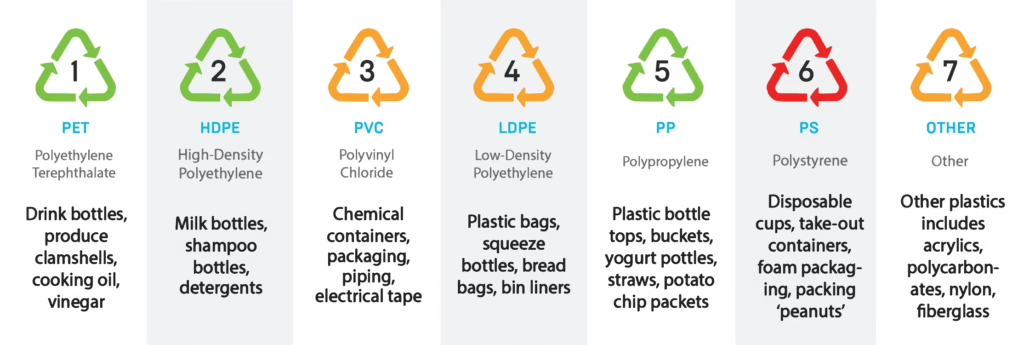
Plastic recycling faces significant challenges. While many materials are efficiently recovered, plastic remains among those with the lowest recycling rates. This doesn’t mean plastic isn’t being recycled—it means our current materials management systems simply can’t keep pace with the vast volume and variety of plastics produced today.
How Can Businesses Improve Recycling Through Packaging?
With many states adopting Extended Producer Responsibility (EPR) laws, businesses are being encouraged to implement more sustainable practices. Now is the time for companies to re-evaluate their packaging strategies—not just for compliance, but for cost efficiency and brand value. Sustainable packaging offers a clear ROI: using less material and designing products with sustainability in mind can reduce production costs while meeting evolving regulatory expectations. Companies that fail to comply with new EPR standards may face fees or penalties, whereas future eco-modulation programs will reward packaging that is highly recyclable or made from recycled and renewable materials.
Implementing new strategies is also important from a business-consumer relationship standpoint. Consumer trust in recycling has declined over the past decade. By 2023, nearly one-third of consumers (32%) doubted that the items they recycle are actually being converted into new materials–let alone new packaging. In response, legislation and industry trends are making recycling simpler and more effective, with a focus on mono-material packaging and clearer recycling labels. Communicating your efforts builds trust and brand loyalty with consumers.
Mono-material packaging—made entirely from a single type of material—is a practical and eco-friendly solution for some businesses. Many mono-materials, including PET (polyethylene), HDPE (high-density polyethylene), and paperboard/cardboard, are widely accepted in recycling programs, making them an excellent choice for businesses looking to improve sustainability and enhance consumer confidence. PET has a well-established recycling infrastructure and can be turned into fibers, new containers, or textiles. Its clear labeling and uniformity make sorting and processing simpler. HDPE is chemically stable, lightweight, and widely accepted in curbside recycling programs. It can be reprocessed into new containers, piping, or plastic lumber. Paperboard and cardboard fibers are easily pulped and remade into new paper products. Corrugated cardboard is especially easy because it’s strong, dry, and usually uncontaminated. Using easily recyclable mono-materials not only simplifies waste management but also strengthens brand reputation by aligning business practices with consumer expectations for sustainability.
How Eco-Friendly and Recyclable Packaging Can Give Businesses a Competitive Advantage
Understanding the difference between recyclable and eco-friendly packaging is essential for businesses looking to meet regulatory requirements, reduce costs, and build consumer trust. While recyclable materials like PET, HDPE, and paperboard play a key role in improving waste recovery, eco-friendly packaging focuses on minimizing environmental impact of the product.
For companies, the shift toward sustainable packaging is not just a compliance issue—it’s a strategic opportunity. By adopting mono-material designs, using renewable or recycled materials and clearly communicating recyclability, businesses can simplify recycling for consumers, demonstrate environmental responsibility, and position themselves as leaders in sustainability.
Ultimately, thoughtful packaging decisions benefit both the planet and the bottom line, making it easier than ever for businesses to turn environmental responsibility into a competitive advantage.
