
How to Cut Packaging Costs Without Sacrificing Quality
Last Updated on June 17, 2026 by Kira Andrus

Long summer days, your favorite coffee order, finding a song you forgot you loved — sometimes the best things are surprisingly simple. The same idea applies to packaging. For growing businesses, smart packaging decisions don’t always mean choosing the thickest material or the most premium option on the shelf.
Sometimes, the best value comes from choosing packaging that fits your product and your budget perfectly.
That’s where value packaging and downgauging strategies can make a big impact.
What Is “Value” Packaging?
Value packaging refers to more economical versions of standard packaging products that still maintain the core qualities businesses need: clarity, protection, food safety, and presentation.
For example, some Crystal Clear bags and boxes are available in slightly thinner gauges that reduce material use while still delivering the same polished appearance customers expect.
At first glance, many businesses can’t visually tell the difference between standard and value packaging options. The difference is often more about feel than appearance.
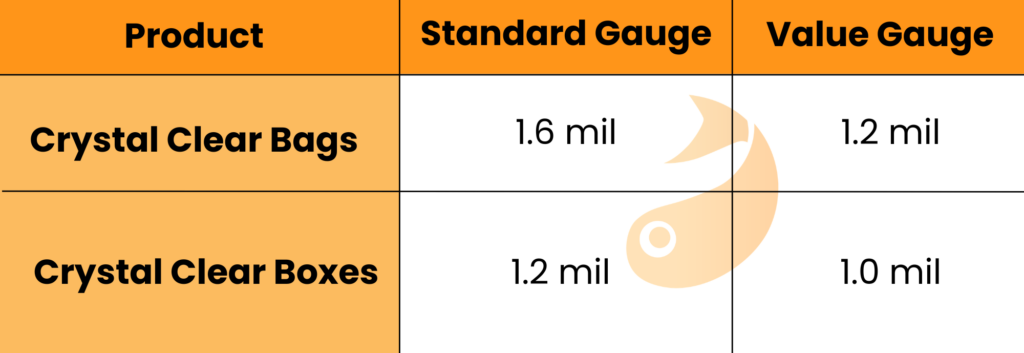
The value line feels slightly lighter and less rigid, while Crystal Clear packaging offers a heavier, more substantial feel. Depending on your product and customer expectations, that difference may matter a lot, or it may not matter at all.
Why Businesses Are Exploring Downgauging
Downgauging simply means reducing packaging thickness or material usage while maintaining performance. It’s becoming increasingly common as businesses look for ways to:
- Reduce packaging costs
- Lower shipping expenses
- Improve sustainability efforts
- Decrease storage space requirements
- Reduce material waste
Advancements in packaging materials have made this easier than ever. Modern plastics like BOPP (Biaxially Oriented Polypropylene) and PET (Polyethylene Terephthalate) are engineered for strength and clarity, even at lighter weights.
For many businesses, downgauging creates an opportunity to improve margins without dramatically changing packaging appearance or functionality.
Check out our blog post for more information about The Benefits of Downgauging.
The Key Question: What Does Your Product Actually Need?
Not every product requires heavy-duty packaging. A lightweight bakery cookie bag has very different packaging needs than hardware, liquids, or bulk powders.
Before switching to thinner packaging, ask:
- Does the product need extra puncture resistance?
- Does shelf life depend on moisture or oxygen barriers?
- Will customers associate heavier packaging with premium quality?
- Is the packaging mainly for display, transport, or long-term storage?
In some cases, lighter packaging works perfectly well. In others, durability and barrier protection should remain the priority.
The goal isn’t always to use less packaging; it’s to use the right packaging.
High Clarity Still Matters
One of the biggest misconceptions about thinner packaging is that it looks cheaper. In reality, downgauged materials can often improve product visibility.
High-clarity packaging helps products look polished, clean, and retail-ready. Crystal clear bags made from BOPP and OPP films maintain excellent transparency while using less material overall.
For businesses selling baked goods, stationery, handmade products, cosmetics, or retail merchandise, product visibility is sometimes more important than packaging thickness.
Cost Savings Add Up Quickly
Small reductions in material costs can create significant long-term savings, especially for businesses shipping high volumes.
For example:
- Standard Bag: 100 pieces at $0.11 each
- Value Bag: 250 pieces at $0.083 each
That difference may seem small at first, but over thousands of orders, reduced material and shipping costs can meaningfully improve margins.
Value packaging can also help businesses:
- Increase order quantities without increasing storage needs
- Reduce shipping weights
- Simplify fulfillment operations
- Maintain profitability during fluctuating material costs
For growing brands, those efficiencies matter.
Sustainability Benefits of Using Less Material
Consumers increasingly expect brands to reduce unnecessary packaging waste. Using lighter-weight materials where appropriate can support sustainability goals without compromising product presentation.
Industry organizations have reported major reductions in plastic use through downgauging initiatives across packaging industries. Less material usage can reduce:
- Raw material consumption
- Transportation emissions
- Storage space requirements
- Landfill waste
Many businesses also use downgauging as an opportunity to communicate sustainability efforts directly to customers.
Simple messaging on packaging or inserts can explain how reducing excess packaging supports environmental goals while still protecting products.
Value Packaging Still Delivers Performance
Economical packaging options still offer many of the same benefits as standard packaging lines, including:
- Food-safe materials
- Acid-free and archival-safe properties
- Excellent product clarity
- Easy assembly
- Reliable sealing and protection
Value bags are commonly available in flap seal and no-flap styles, while value boxes remain easy to fold, assemble, and merchandise for retail display.
For many businesses, the difference comes down to customer experience and branding priorities.
If your packaging is central to the luxury feel of your product, heavier materials may reinforce that premium perception. But if your goal is clean presentation, efficient protection, and cost control, value packaging may be the smarter choice.
Packaging Smarter, Not Bigger
Today’s businesses are balancing rising shipping costs, sustainability goals, and customer expectations all at once. Creative packaging strategies like downgauging help companies stay competitive without sacrificing quality.
Sometimes the smartest packaging solution isn’t the most expensive option. Rather, it’s the one that delivers exactly what your product needs, nothing more and nothing less.
And just like the simple things in life, thoughtful packaging choices can create long-term value in ways that really add up.
